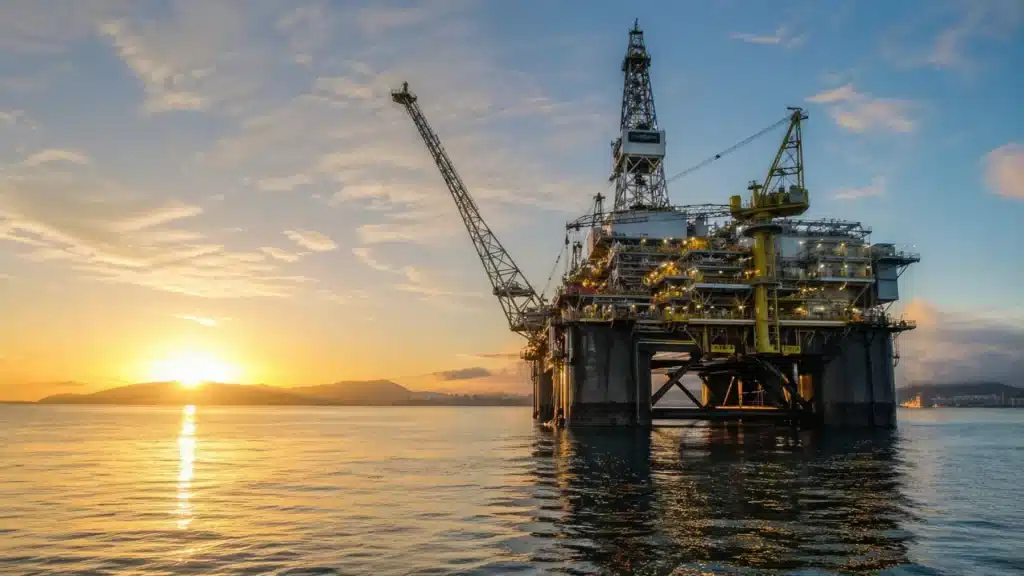
The sector of oil and gas in Brazil is undergoing a technical and operational restructuring that defines new guidelines for 2026.
For the entrepreneur planning to invest or expand operations in the country, the scenario is characterized by the maturity of Pre-salt fields, the opening of the natural gas market, and a global push for cost efficiency and digitalization.
This article analyzes market projections, infrastructure challenges, and the administrative solutions required to operate in Brazil.
The production landscape of Oil and Gas in Brazil
Brazil has consolidated its position among the ten largest global oil producers, with production exceeding 3 million barrels per day.
For 2026, the commencement of operations for new Floating Production Storage and Offloading (FPSO) units in strategic basins, such as Santos and Campos, is expected to drive these indicators higher. The competitiveness of oil and gas in Brazil lies in the low lifting costs of the Pre-salt, which remains viable even in scenarios of Brent crude price volatility.
However, the growth of national production occurs within a context of global caution. Projections indicate that only 15% to 25% of companies in the sector will achieve revenue growth above 5% in 2026. This data signals that while extraction volume is increasing, profitability will depend directly on capital discipline and operational cost management.
Digitalization and operational efficiency in 2026
Technology has shifted from being a differentiator to the foundation of operational survival in the sector.
It is estimated that in 2026, the industry will accelerate the transition from pilot projects to full-scale deployment of Artificial Intelligence (AI) and Generative AI.
Investment in AI and automation
Spending on AI and Generative AI by oil and gas companies in Brazil, and global companies, is projected to represent more than 50% of total IT budgets by 2029. The primary investment focuses are:
- Process optimization: approximately 50% of AI investment in the sector is directed toward adjusting drilling parameters and production rates in real-time. Predictive algorithms can reduce downtime and protect operational uptime by approximately 1.6%.
- Asset performance: utilizing robotics and drones for automated inspections on platforms is fundamental for aging assets that carry higher risks of technical standstills. Companies adopting these systems report up to 40% fewer equipment failures.
- Connected workers: with 66% of the O&G workforce in mechanically intensive roles, the use of AI-enabled training and engagement platforms speeds up onboarding and knowledge retention.
- Environmental management: even with delayed implementation of certain leak detection requirements until 2027, the need to automate reporting through sensor networks and real-time analytics is becoming an operational standard.
The Natural Gas and LNG market
The expansion of oil and gas in Brazil is also fueled by Liquefied Natural Gas (LNG).
Global LNG demand is projected to grow 60% by 2040. In Brazil, the New Gas Law has allowed for the breaking of the state monopoly, encouraging private investment in pipelines and regasification terminals.
In 2026, integrating national gas into the industrial matrix will be a determining factor in reducing energy costs. LNG is expected to act as a transition fuel, meeting the rising energy demand from data centers and large-scale industrial projects.
Cost pressures and supply chain challenges
Implementing new oil and gas in Brazil projects faces inflationary challenges. Import tariffs on steel, aluminum, and specialized components like compressors and pumps can raise total costs between 4% and 40%.
Projected cost increases for 2026:
- Offshore project costs: estimated increase of 8%.
- Onshore service costs: estimated increase of 6%.
- LNG construction costs: estimated increase of 4.6%.
- Drilling and completion costs: estimated increase of 4.5%.
These pressures force companies to strengthen local supply chains.
The trend for 2026 is the prioritization of resilience over minimum cost, utilizing domestic suppliers or those located in non-tariffed zones to mitigate fiscal risks.
Decarbonization and renewable fuels
The oil and gas in Brazil sector is adapting to meet global environmental standards. The focus in 2026 will be on reducing methane emissions and developing low-carbon fuels.
- Renewable Diesel (RD) and SAF: global demand for Sustainable Aviation Fuel (SAF) is expected to increase eightfold between 2025 and 2030. In Brazil, refineries are being adapted for the co-processing of renewable feedstocks.
- Refining rationalization: refiners are focusing on operational efficiency and product optimization as global competition increases. Feedstock flexibility will be a priority to counter uncertain demand and margin pressures.
Read: Tax reform: what changes for national and foreign companies in 2026
Business structuring and compliance in Brazil
Investing in the oil and gas in Brazil requires an understanding of a complex tax structure. The profitability of a project can be compromised by poor tax management or ignorance of specific energy sector fiscal incentives.
You’ll find below some critical aspects to be considered.
Critical aspects for the investor:
- Special regimes (REPETRO): correct use of this special customs regime allows for the import of goods intended for exploration and production without the incidence of federal taxes, significantly reducing initial CAPEX.
- Bureaucracy and company formation: the time required to establish a legal entity in Brazil can vary. Having a local partner to accelerate registration with regulatory bodies (such as the ANP) is essential to meet investment schedules.
- HR Management and Payroll: Brazilian labor laws and specific norms for offshore work require precise payroll administration in compliance with local unions.
- Capital discipline: between 2022 and 2025, nearly 45% of O&G cash flows have gone to dividends and buybacks. Maintaining financial restraint while managing policy changes is vital for medium to large firms.
Read: Accounting in Brazil: how Europartner can simplify business for you
The strategic role of Europartner
Europartner serves as the administrative arm for foreign companies wishing to enter the oil and gas in Brazil market. With a focus on efficiency and risk reduction, we offer complete solutions in Accounting, Tax, and Human Resources BPO.
Our experience allows investors to focus on their core business while we ensure that the Brazilian operation is in full compliance with local legislation.
In 2026, where capital discipline is the priority, avoiding administrative errors and tax penalties is a determining factor for success.
Your business and Europartner
The outlook for the oil and gas in Brazil sector from 2026 is one of sustained growth supported by technology and deep-water exploration. Although the global landscape presents cost pressures and tariff uncertainties, Brazil maintains high-productivity assets that attract foreign capital.
Operational success will depend on the ability to integrate artificial intelligence into production, manage supply chains with a focus on resilience, and ensure a solid administrative structure that supports expansion without losses due to bureaucratic inefficiency.
Is your company planning to enter the Brazilian energy sector in 2026?
Visit the Europartner website and discover how our specialized consultancy can facilitate your international expansion with security and agility.
Contact us today and talk to our specialists.
*The data is this article can be found in: 2026 Oil and Gas Industry Outlook